Case Study
Regenerating rural communities through digital infrastructure

Scroll
Client
Garbe DC
Location
Denmark
Status
2015 - Ongoing
Capacity
350 MW
Partners
Ramboll
Services
Blueprint - Vision
Overview
A 35 hectare site inside Business Park Falster with 350MW of available power, and 3km of public ecological route running straight through it. The question was how to use the power fully without severing the landscape it sits in.
The Falster Technology Campus brings together two conditions that are often treated separately: substantial digital infrastructure capacity and an existing rural landscape. The 35-hectare site has access to 350MW of power, while a three-kilometre public ecological route passes directly through it. The project began with a simple tension: how to use the available power fully without turning the development into a closed technical estate.
The challenge
Large data centre campuses tend naturally towards consolidation. Security, servicing, power and cooling all encourage a compact and highly controlled environment. The landscape asked for something different. The ecological route needed continuity, public access and a stronger relationship with the wider territory.
The problem was therefore not simply one of accommodating capacity. It was to determine whether a major digital infrastructure campus could also become a mechanism for improving the landscape through which it passes.
Design response
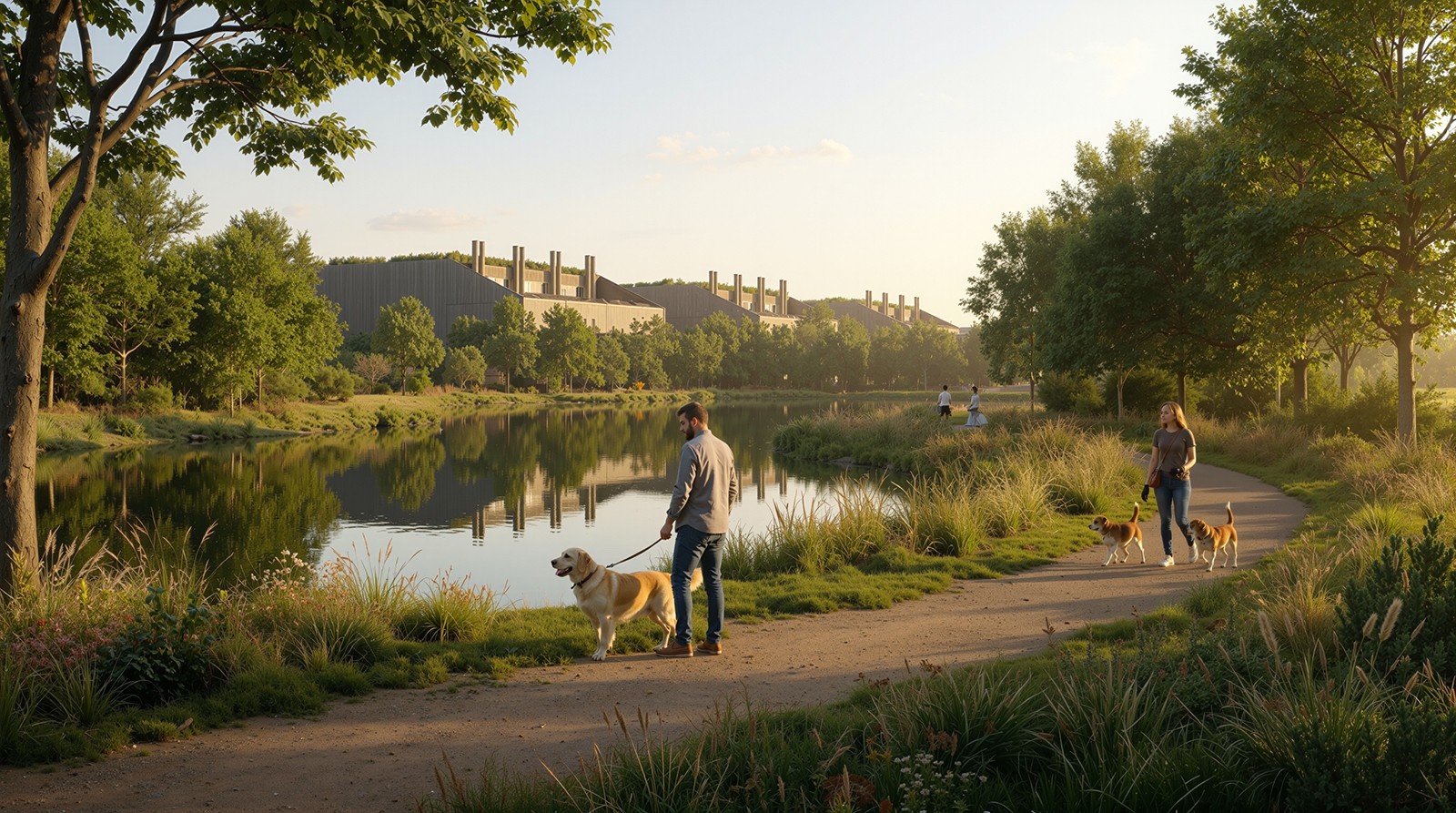
A configurable reference design allowed the site to be tested through different combinations of data centre, workplace and logistics uses without fixing the masterplan too early. At the same time, the ecological route was treated as an organising element rather than as residual space between technical plots.
A coordinated cut-and-fill strategy reshapes the ground to improve drainage and water retention while creating the terrain through which the route passes. Water management, biodiversity and public movement are held within the same physical system. The landscape therefore does more than screen the development. It carries infrastructure, structures the campus and connects it to the surrounding rural environment.
Outcome
The result is a 350MW campus organised around three kilometres of regenerated public landscape. Its blue-green infrastructure manages water, extends habitat, carries the ecological route and gives the development its spatial order.
The project explores a wider proposition for rural digital infrastructure: that large technical estates can create new forms of landscape value rather than simply consume land.